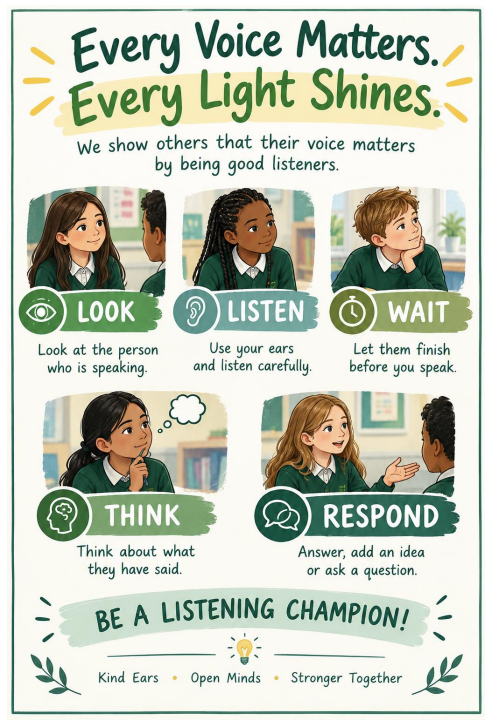
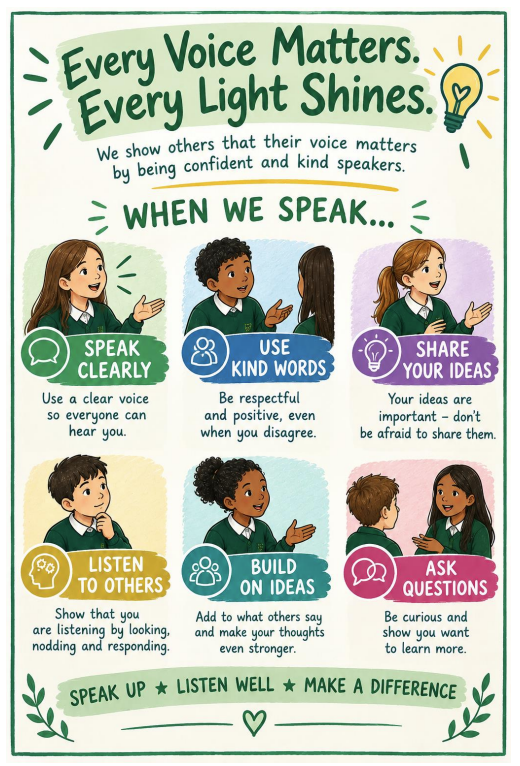
Building on our vision and values and the National Curriculum for spoken language, we aim to provide an exceptional oracy education that embraces our school vision. The basic skills of spoken language are vital for the life opportunities for our children. We believe that ‘Every light shines, Every voice matters’.
At Whinmoor St Paul’s, we aim for all children to let their light shine and know that excellent oracy skills are one way that they can do this both now and in the future.
Intent
At Whinmoor St. Paul’s, we prioritise language development, recognising its crucial role for our pupils. This commitment propels us to enhance spoken language, listening skills and vocabulary, positively impacting on their reading and writing as well as all their learning in all other subjects. By integrating the school vision into our oracy curriculum, we aim to create a learning environment that promotes collaboration, celebrates achievement and fosters empathy and respect. Our curriculum reflects a comprehensive approach to high-quality oracy skills, addressing physical, linguistic, cognitive, social and emotional aspects. With elevated expectations, the entire school community upholds standards for children’s spoken language and listening skills. We believe tolerance, articulate expression, collaborative abilities, and confidence in sharing views are indispensable life skills fostering success in both learning and life. Through our commitment to excellence, inclusivity and holistic development, we aim to empower our pupils to make a positive impact in their communities and the wider world.
Our curriculum will enable children to:
Implementation
At Whinmoor St. Paul’s, we follow an oracy progression map that provides planned opportunities in every year group, starting in the EYFS, for every pupil to develop their proficiency in the components of spoken language also equipping them with the necessary listening skills. This includes the explicit teaching of vocabulary and ideas necessary for effective communication. In order to become improved speakers and listeners, pupils also need opportunities to practise, refine and apply this knowledge in a range of different contexts and for a range of different audiences. The four strands of oracy are planned for each year group and include: physical, linguistic, cognitive and social and emotional aspects. Planned opportunities include teachers modelling the physical, linguistic, cognitive, social and emotional aspects of spoken language using forms of speech that children may not have encountered previously. Teachers use progressive sentence stems and new vocabulary to help children speak for different purposes and audiences.
Communication and language is at the heart of our EYFS. High quality conversations and questioning take place at every opportunity with practitioners modelling speaking in full sentences. The SHrec approach is used throughout the EYFS to ensure every interaction is effective and maximises learning in every area of the EYFS. Developing pupil’s oral composition through the frequent retelling of stories, effective adult interactions and rhymes and poems is a key element of our language rich curriculum. New vocabulary is specifically planned into the curriculum to support language acquisition. Talk partners are integral in our lessons where children support each other in their learning.
Across KS1 and KS2, children are immersed in a rich environment where they observe their teachers demonstrating high-quality oracy skills, while simultaneously being encouraged to hone their own speaking abilities. This happens through a variety of informal channels, such as sharing books, participating in relational circle sessions, engaging in spontaneous discussions, and responding to cold-call questions during lessons. In addition to these informal interactions, there are also structured opportunities for formal oracy development. These include exercises in verbal reasoning, planned debates, presentations, and discussion sessions aimed at assessing and enhancing understanding across all subjects whenever possible. We use Alex Quigley’s ‘ABC Discussion Model’ across school to ensure children are taught how to have effective group discussions and value opinions different to theirs in planned ‘Talking Tuesday’ debate sessions. Throughout these experiences, children are equipped with the necessary skills to thrive and build confidence in their communication abilities.
Impact
At Whinmoor St. Paul’s our aim is to keep all the children working together at broadly the same place by taking small steps in their learning. We believe that ‘Every light shines, Every voice matters’ and put in appropriate scaffolds and intervention when gaps are recognised. We assess and celebrate even the smallest progressive steps and regular, formative teacher assessment allows us to address gaps and intervene to ensure every child can use their voice well and know that their onions matter!
Staff Development
Our regular auditing identified where staff development was necessary and training has been provided in the autumn term to develop speaking skills. The subject leaders are keen to share best practice and staff have observed them deliver quality interactions and discussions where the ABC approach has been used. This will ensure oracy is constantly evolving to meet the demands of curriculum expectations and prepare our children for current events.
Monitoring
The subject leader, SLT and Governors all play a role in the monitoring of oracy at Whinmoor St. Paul’s. Regular monitoring via learning walks, book looks and pupil/staff voice feedback ensures the oracy is constantly being reviewed and regulated to ensure the best learning opportunities for all.